
How to watch bats
A lazy summer employee guide

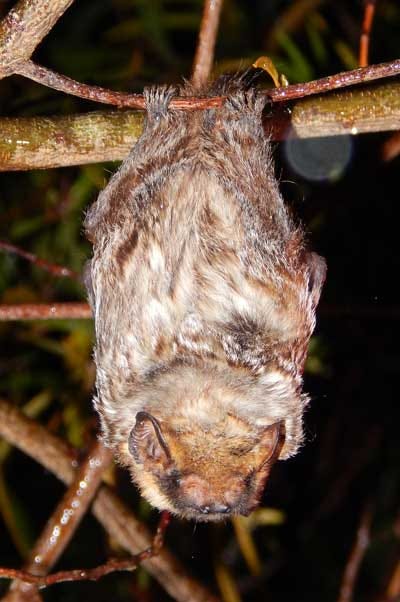
Recently, I mentioned my experience as a summer ranger at a state park, which is a job title more significant than it sounds, especially when cleaning 17 outhouses first thing in the morning. Living the dream, I was not.
At the other end of the day, and the opposite end of the job’s enjoyment, were the nighttime patrols through the campgrounds, beach and boat ramps in a blue Dodge pickup. The park was generally quiet, and the campers were well-behaved, which led to a lot of free time.
My favorite break was to watch the bats. There was a big yellow yard light at a public beach, and it drew insects and the bats. Using their echolocation skills, bats fed on the bugs that were attracted to the light, swooping and swishing through the air at dizzying speeds, grabbing whatever unfortunate moth happened to be cozying up to the illumination. I would sit on the truck’s tailgate and watch until I felt guilty about not “working” and return in an hour or so after making another round. As far as I know, the feeding went on all night.
The park was in Iowa, which has nine native species of bats; I could not tell you which were feasting, and perhaps it was more than one type, although they looked about the same size. All nine species are aerial insectivores, so that didn’t help with any identification.
The largest Iowa native is the hoary bat, with a 16-inch wingspan (as big as a robin); the smallest is the tricolored bat, which stretches to 7 inches. Although they were hard to appreciate in real time, bats often perform tricky aerial maneuvers while feeding, including flipping upside down while catching their prey with their feet. Or is this just showing off for other bats? Bats have clawed thumbs, which makes it easier to grab a bug and hang on.
They also supped while flying, but they are messy eaters; I would find small bits of moth wings and thoraxes on the ground under the light. Even the tricolor, the smallest bat, can eat 1,200 insects in a night.
Not everyone likes bats, for reasons valid and less so. Bats are a leading cause of death via rabies, but the fatality number is 7 to 10 people per year across the entire United States. Fewer than 1 percent of the animals carry the virus.
In popular culture – Batman aside – excellent films such as 1930s The Bat Whispers, in which the master criminal wears a black mask and a cape and flings his arms to look like wings, added to the cultural unease about the animal. And I haven’t even mentioned vampire bats, which, to be fair, do drink the blood of other animals (hematophagy), but the nearest one in the wild is in Central America. Then, of course, there is the usage of bats as epithets and putdowns: batsh*t crazy, blind as a bat, bats in the belfry, old bat, bat out of hell. Those phrases didn’t help the bats’ PR efforts.
Two of the native species, the Northern long-eared bat and the little brown bat, are at risk because of the well-documented white-nose syndrome. It’s a fungus that grows in places such as warm, moist caves where these bats hibernate; the big brown bat, by contrast, can tolerate freezing temperatures where the fungus does not grow and is less affected by the syndrome. Northern long-eared bats are a federally threatened species, and the Indiana bat, another Iowa native, is worse off and considered endangered. As an endangered species, the law protects the Indiana bat even if it is living in your chimney. So avoid swatting it with your tennis racket.
Years ago, we put up a bat house on a shagbark hickory tree on the property, but it did not suit the neighborhood bats and remains unoccupied. We couldn’t pay a bat to stay there. It’s possible that predators – owls, raccoons, hawks -- could get to the box and the smart bats avoided it. Large trees with loose bark, like the hickory, are supposed to be suitable homes, but you know the old real estate truism: location, location, location. Or should it be echolocation?
-30-